Insights · Delta Roofing
How to Know When a Commercial Roof Needs Full Replacement
Age does not decide when a commercial roof needs replacing — the pattern of repairs does. Here is how to tell a roof with failed details from a roof that is genuinely finished.
Article
Commercial roofs rarely fail all at once. They fail gradually, in details, which is what makes the replacement decision so easy to get wrong in both directions — replacing a roof that had years left, or repairing one that stopped being repairable some time ago.
Age is the usual tiebreaker, and it is the wrong one.
The signal is the pattern, not the leak
An isolated failure is normal maintenance. A membrane puncture, a loose flashing, a blocked drain — these are repairs, and a roof needing them is a roof behaving as expected.
What matters is whether repairs hold. If the same areas keep leaking, if seams continue to open after being closed, or if a new failure appears every time the weather turns, the repairs are no longer solving anything. They are buying increasingly short amounts of time.
A repair every few years is a maintained roof. Repeated repairs in the same season are a roof telling you something.
What to look for
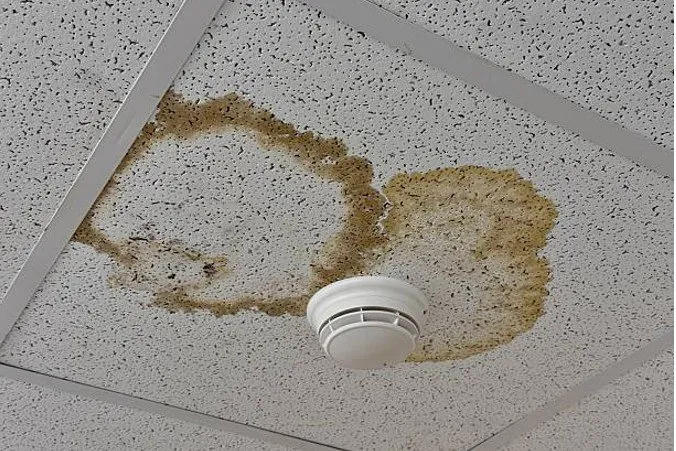
- Widespread membrane wear, not confined to one area
- Ponding that recurs in the same places after every rain
- Brittle or cracking materials
- Repeated seam failures
- Failing flashing details across multiple locations
- Sections that no longer respond well to repair
The common thread is distribution. Any one of these in one place is a repair. The same one appearing across large areas, or after every major weather event, points at the system rather than the spot.
Age matters, condition matters more
Some roofs perform well past their expected service life because they were well detailed and maintained. Others decline early because they were not, or because the building changed around them.
The better question is not "how old is this roof" but "how is it performing now, and what is the trend". A twenty-five-year-old roof holding steady is not a replacement candidate. A fifteen-year-old roof failing in new places every season may be.
Hidden moisture usually decides it
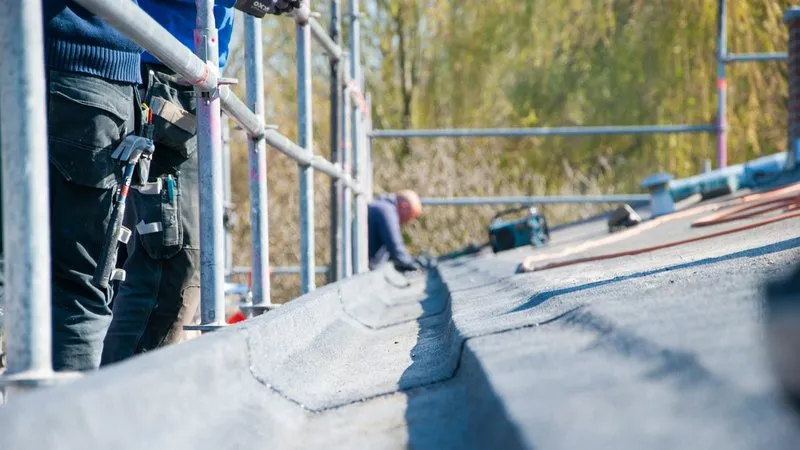
A roof can look manageable from the surface while moisture spreads through the insulation below. That is the condition that most often turns a repair into a replacement, because saturated insulation cannot be repaired — only removed.
It is also the condition you cannot assess by looking. Moisture surveys and condition analysis exist precisely because the surface does not tell you.
Where coatings fit, and where they do not
If the roof is structurally sound and the wear is mostly at the surface, a restoration coating can add years for a fraction of a tear-off. That is a genuinely good outcome, and it is available on more roofs than people assume.
It is not available on all of them. A roof with widespread saturation, failed seams throughout or recurring structural issues will not be fixed by a coating — it will be sealed with the problem inside. Anyone offering to coat a roof without first establishing whether it is dry is selling you a delay, not a solution.
Which is why the sequence matters: establish the condition, then choose between repair, restoration and replacement. Not the other way round.
Get expert help
Have a question about your roof?
Book a free on-site assessment and we'll give you a straight answer grounded in your actual building.
Get started
Request a quote or roof assessment
Tell us about your building and roof. We respond fast, usually the same business day, and can book an on-site assessment.
- No-obligation written proposal
- Property & facility managers welcome
- Emergencies? Call (416) 798-0977