Insights · Delta Roofing
Infrared Drone Inspections, A Smarter Way to Detect Flat Roof Moisture
You cannot see wet insulation from the surface of a flat roof. A thermal scan can — it reads the heat that saturated insulation holds after sunset, which is how a small breach gets found before it becomes a large one.
Article
The hardest thing to find on a flat roof is water that has already got in. It enters through a seam, a flashing or a penetration, spreads sideways through the insulation, and gives no sign at all until it finally shows up on a ceiling — by which time the wet area is considerably larger than the hole that caused it.
That delay is what makes moisture expensive. It is also what a thermal scan is for.
How an infrared inspection differs from a walk-over
A visual inspection reports what can be seen on the surface. An infrared scan reads temperature instead. Saturated insulation holds heat differently from dry insulation, so as the roof cools the wet areas stay warm longer — and the shape of the moisture shows up as a clear pattern that is invisible in daylight.
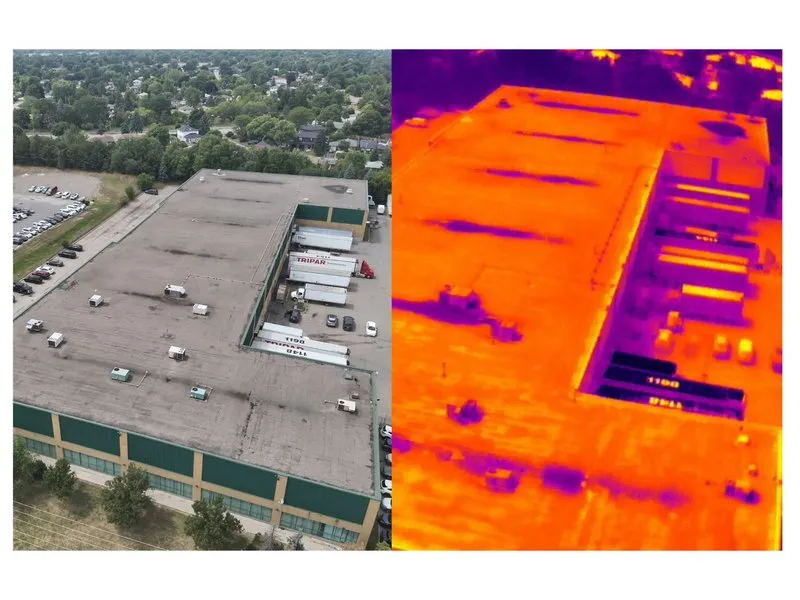
On a flat roof, where moisture can travel well away from its entry point and keep spreading below an intact-looking membrane, that difference matters more than it does anywhere else on a building.
When it is worth doing
- Leaks that keep returning to the same area after being repaired
- A leak whose source is genuinely unclear
- Insulation performance that seems to be dropping
- Known trouble spots you want mapped rather than guessed at
- Any roof you are about to budget major work against
That last case is the most valuable and the least used. Deciding between repair, restoration and replacement on the basis of a surface walk-over is guesswork. Deciding it on a moisture map is not.
Why better detection changes the repair, not just the diagnosis
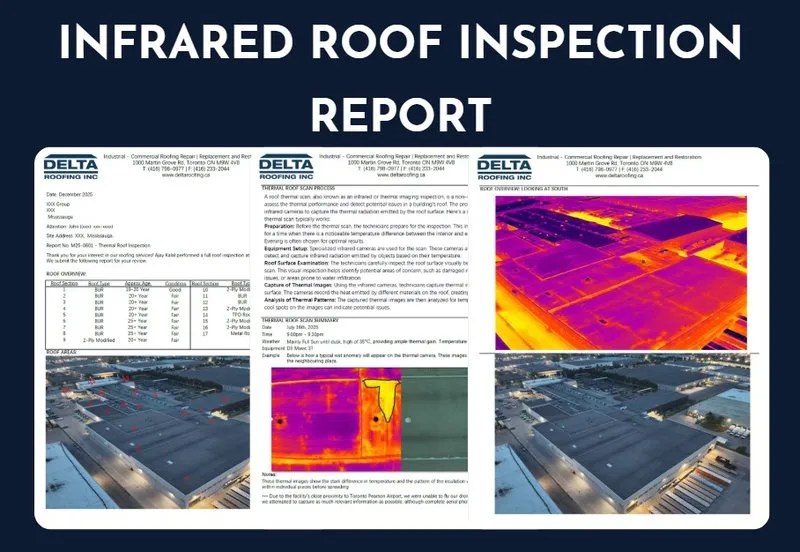
Finding moisture is only half of it. The useful part is knowing how much and where.
If the wet area is one section, the repair can be cut back to sound material and stopped there. If it runs across a third of the roof, that is a different conversation and a different budget — and far better to have it now than after another two winters of spreading.
Scan after rooftop work
Flat roofs change: HVAC units get added, mechanical systems replaced, new penetrations cut. Every one of those is a new detail, and new details are where moisture starts. A scan after rooftop work confirms whether the detailing held — while the trail is short enough to follow.
If you suspect hidden moisture, or you are budgeting work on a roof nobody has mapped, an inspection is the place to start.
Get expert help
Have a question about your roof?
Book a free on-site assessment and we'll give you a straight answer grounded in your actual building.
Get started
Request a quote or roof assessment
Tell us about your building and roof. We respond fast, usually the same business day, and can book an on-site assessment.
- No-obligation written proposal
- Property & facility managers welcome
- Emergencies? Call (416) 798-0977